Automation in Web Development: Processes and Advantages
A website can do far more than simply display information, attract visitors, or showcase a service catalog. When its architecture incorporates web development automation, the site can execute actions, transfer data between platforms, and trigger business processes without relying on constant manual intervention.
A user might fill out a form, and within seconds, their data is validated, logged in a CRM, assigned to a salesperson, categorized by the requested service, and used to trigger a notification or a follow-up sequence.
From the visitor’s perspective, only one action took place: submitting a form.
Behind the scenes, however, an entire workflow may have been executed.
This distinction is significant because modern web development is no longer just about designing visually appealing pages. It is increasingly about connecting systems, eliminating repetitive tasks, and transforming the website into an active component of a company’s operations.
What is automation in web development?
Web development automations are processes programmed to execute an action when a specific event occurs within a webpage, application, or connected system. The basic logic can be summarized as:
- Event → Condition → Action → Result.
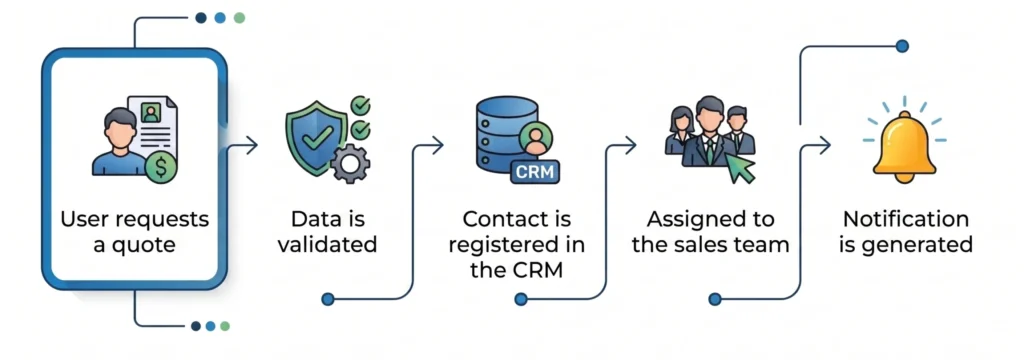
Without automation, each of those tasks might require human intervention. However, with a properly developed integration, the various systems exchange information automatically.
Therefore, web automation is not just about installing an external tool. In more advanced projects, it involves designing how the site will behave when it receives information and how it will communicate with the business’s other platforms.
What processes can a website automate?
Not all companies require the same automation processes. The decision should be based on identifying what happens after each key user action.
Here are some of the most impactful applications:
1. Forms connected to a CRM:
One of the most practical uses of web process automation is connecting forms directly to customer management platforms.
Instead of simply receiving an email with the prospect’s details, the system can:
- Validate fields before processing them.
- Identify the requested service.
- Automatically register the contact.
- Assign tags or segments.
- Determine the acquisition source.
- Assign the lead to the appropriate team.
- Generate a sales task.
- Initiate a follow-up process.
This also improves data quality. If a company receives leads from Google Ads, Meta Ads, and various landing pages, automation allows it to store information alongside the prospect—such as the campaign, source page, or requested service.
The form thus ceases to be a mere point of contact and becomes the entry point for a sales workflow.
2. Booking and appointment automation:
Businesses that handle consultations, meetings, professional services, or in-person appointments can connect their websites to scheduling systems.
The workflow can allow a user to:
- Select a service → Check availability → Book → Receive confirmation → Get a reminder.
Depending on the project, additional actions can be incorporated after the appointment, such as requesting documentation, sending instructions, or triggering follow-up communications.
The benefit lies not only in saving administrative time but also in eliminating unnecessary steps between user intent and conversion.
3. API integrations between the website and other systems:
API integrations are a crucial component of automated web development.
An API enables different applications to exchange information and execute actions with one another. Thanks to this type of integration, a website can communicate with:
- CRMs.
- Payment platforms.
- Inventory software.
- ERP systems.
- Shipping services.
- Email marketing tools.
- Internal applications.
- Booking systems.
- Customer support
- platforms.
- External services.
For example, after a purchase, an e-commerce site could update inventory, record the order in another system, and send logistics information without the need for manual data entry.
API-based automation becomes particularly important when a company uses multiple applications that need to function as a single digital ecosystem.
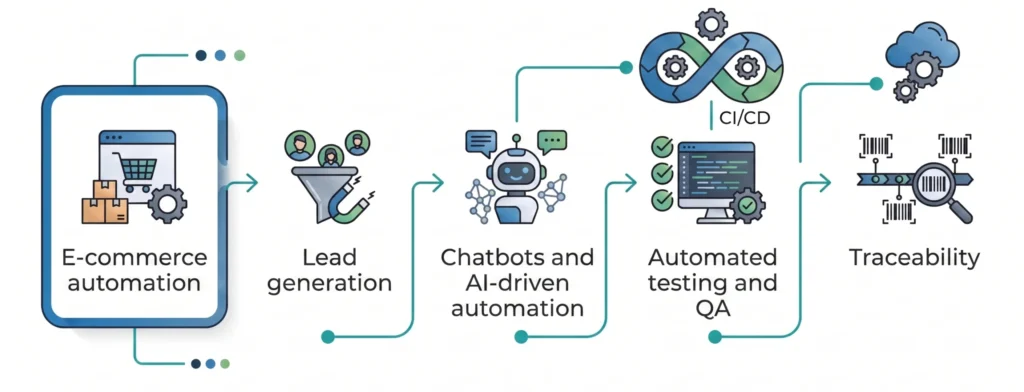
Other Processes You Can Automate
When does a company need web automation?
There are some fairly clear signs indicating when it is time to consider automation—specifically, when your team:
- Regularly copies data from one platform to another.
- Receives forms that must subsequently be manually categorized.
- Updates identical information across multiple systems.
- Confirms appointments or requests one by one.
- Loses prospects because follow-up takes too long.
- Struggles to identify the source of opportunities.
- Needs to consult multiple applications to complete a single operation.
- Performs repetitive administrative tasks after every sale.
The future of web development is connecting processes.
For years, many companies evaluated a website primarily based on its design. Today, a website can play a much broader role: it can capture data, interpret events, query external services, update platforms, initiate communications, automate operations, and provide information to various teams.
That is why automation in web development is transforming websites into infrastructure connected to sales, marketing, and operations.
The goal shouldn’t simply be to have a site that “does more things.” It should be to build a system where every significant user action can trigger the right process—with minimal friction and while maintaining control over the data.
When that happens, automation ceases to be merely a technical feature and becomes a tool for better operations.
Automate your processes with Websell
At Websell, we can help you transform manual, repetitive tasks into more efficient digital solutions. We specialize in web development, integrations, and process automation, creating solutions tailored to the specific needs of each business.
Do you have an idea or a process you want to automate? Tell us about your project and get free advice from our team. You can also speak directly with a sales consultant to explore the best options for your company.
Let us know what you need to automate and discover how we can help.

Do you have an idea or a process you want to automate? Describe your project to us and receive free advice.
You can also speak directly with a sales advisor to evaluate the best options for your company.
Tell us what you need to automate and discover how we can help you!